Photos by Eda Temucin
 

Aurelie explained the basics of how LLMs (Large Language Models) and Transformer architecture work. She discussed the background to the narratives of the tech giants with us and outlined her approach to promoting small, interconnected, specialised and decentralised language models as an alternative European strategy.

Together with NODE and the display team, she will bring to life a very small, local and resource-efficient chatbot, which, together with the meetup community, is set to gradually learn to speak and get to know the local digital community from 2026 onwards!

We had a lot of fun, yummy soup and were happy to have you with us <3


Contributors

 
  • soft opening!

  • 2 moderators

  • 1 contributor

  • 41 community members

  • meetup #22.2

  • potato stew

Funding

The project is funded in the program “Promotion of Cultural and Creative Industries Institutions” by the Hessian Ministry of Economy, Energy, Transport and Housing.


In collaboration with

 
Photos by Eda Temucin
 

After some opening words from Franziska Schüller as part of the Geschäftsstelle Kreativwirtschaft Hessen, we started our meetup this time by getting into conversation and having some delicious, hot and vegan chili sin carne, before enjoying the main course of our evening: The Three Body No Problem.

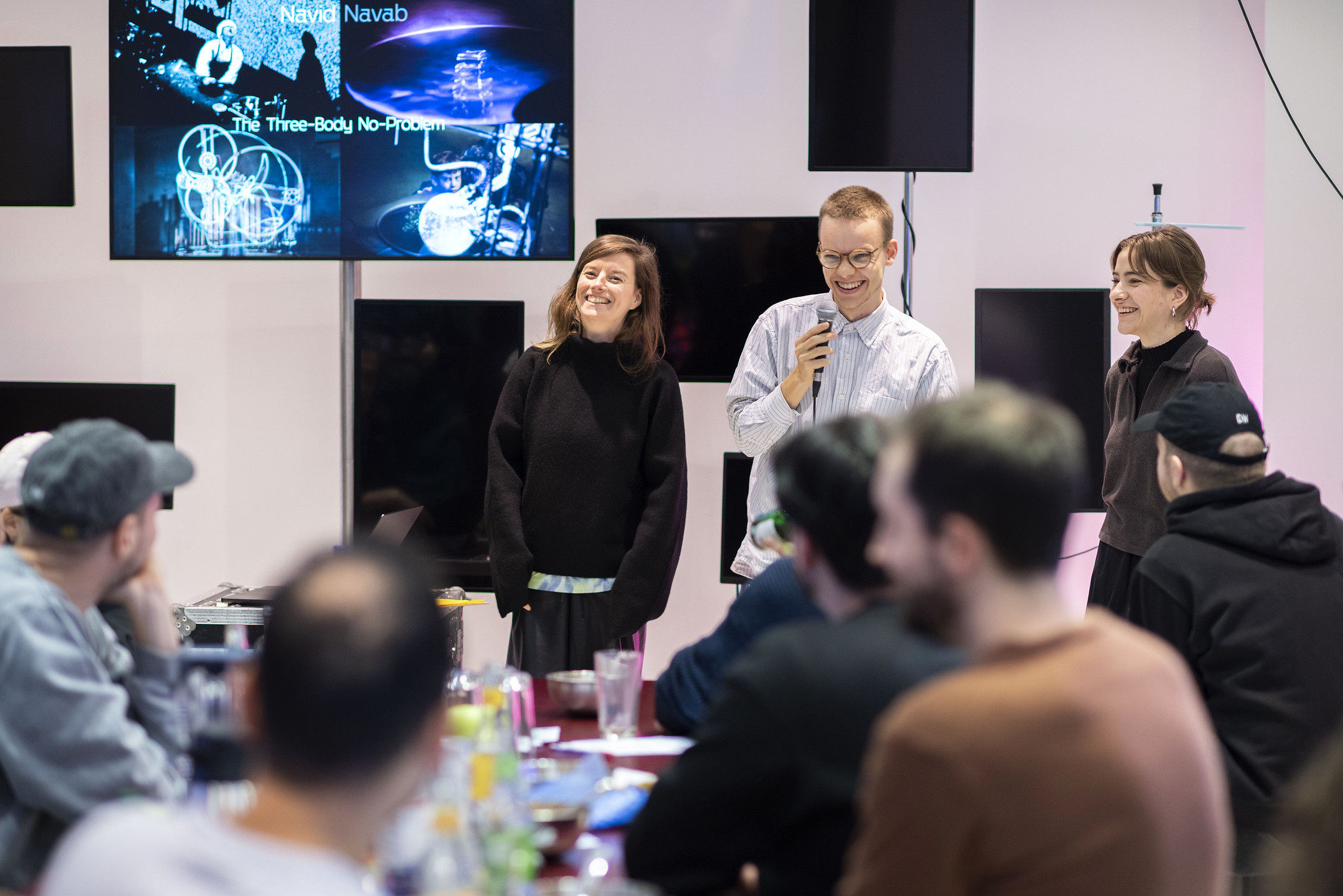
How to work with wild, unpredictable processes, in which lively beings have a central role? In this participatory keynote, art-scientist and this year’s Golden Nica: Prix Ars Electronica winner Navid Navab invited us into a world of alchemical investigations – a world in which the practice of scientific measurement is opened to the senses for attunement towards the unquantifiable movement of life.

Drawing from insights from biological philosophy and tabletop astrophysics, Navab asked: How does matter develop inner time and a sense of intentionality? How may we attune to this generative movement and embrace it as a collaborating designer or performer? After sharing their research, Navab shared their process in a practical and interactive way.

We are so happy so many of you made their way to display, discussed, ate soup and had a drink with us, inaugurating our new space for digital culture. Thank you for coming 🙂

Only two days after, we were happy to host another NODE+CODE meetup: #22.2 – How to build a bot from scratch. Read more about it here!


Contributors

 
  • soft opening!

  • 3 moderators

  • 1 contributor

  • 52 community members

  • meetup #22.1

  • vegan chili sin carne

Funding

The project is funded in the program “Promotion of Cultural and Creative Industries Institutions” by the Hessian Ministry of Economy, Energy, Transport and Housing.


In collaboration with


[EN]

Our Soft Opening Week was the very first test run for display and the space already felt alive, warm and full of potential. 


what is display?

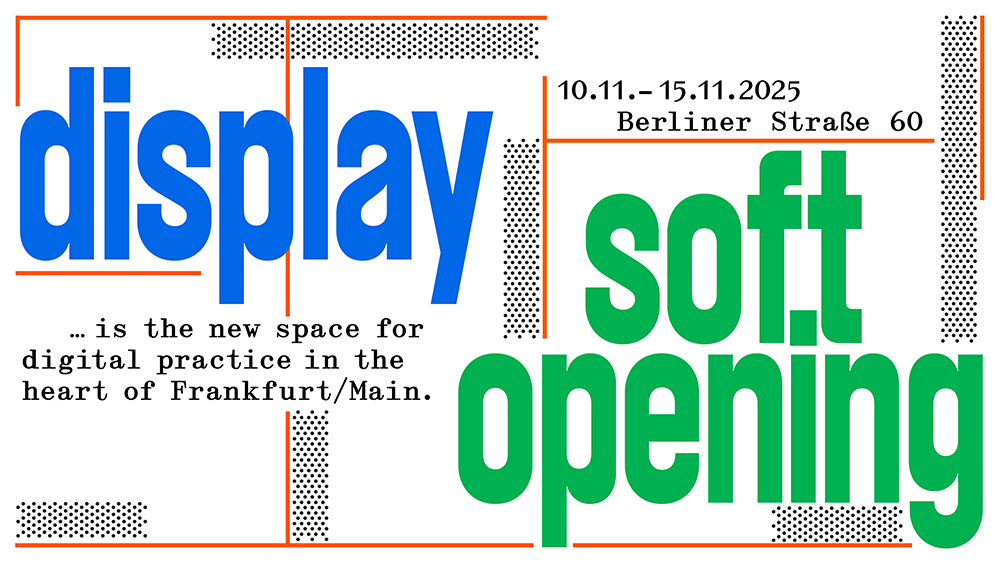
display will be the new space for digital practice in the center of Frankfurt. As a walk-in screen and interface, experimental laboratory, and community space, it promotes creative, critical, and practical engagement with technology.

The space is being planned and implemented in cooperation with the Digitalization Department of the City of Frankfurt am Main. Together, we are creating space for workshops, community, discourse, and networking, thus forming an interface between our fields of interest and the urban community.


a soft start…

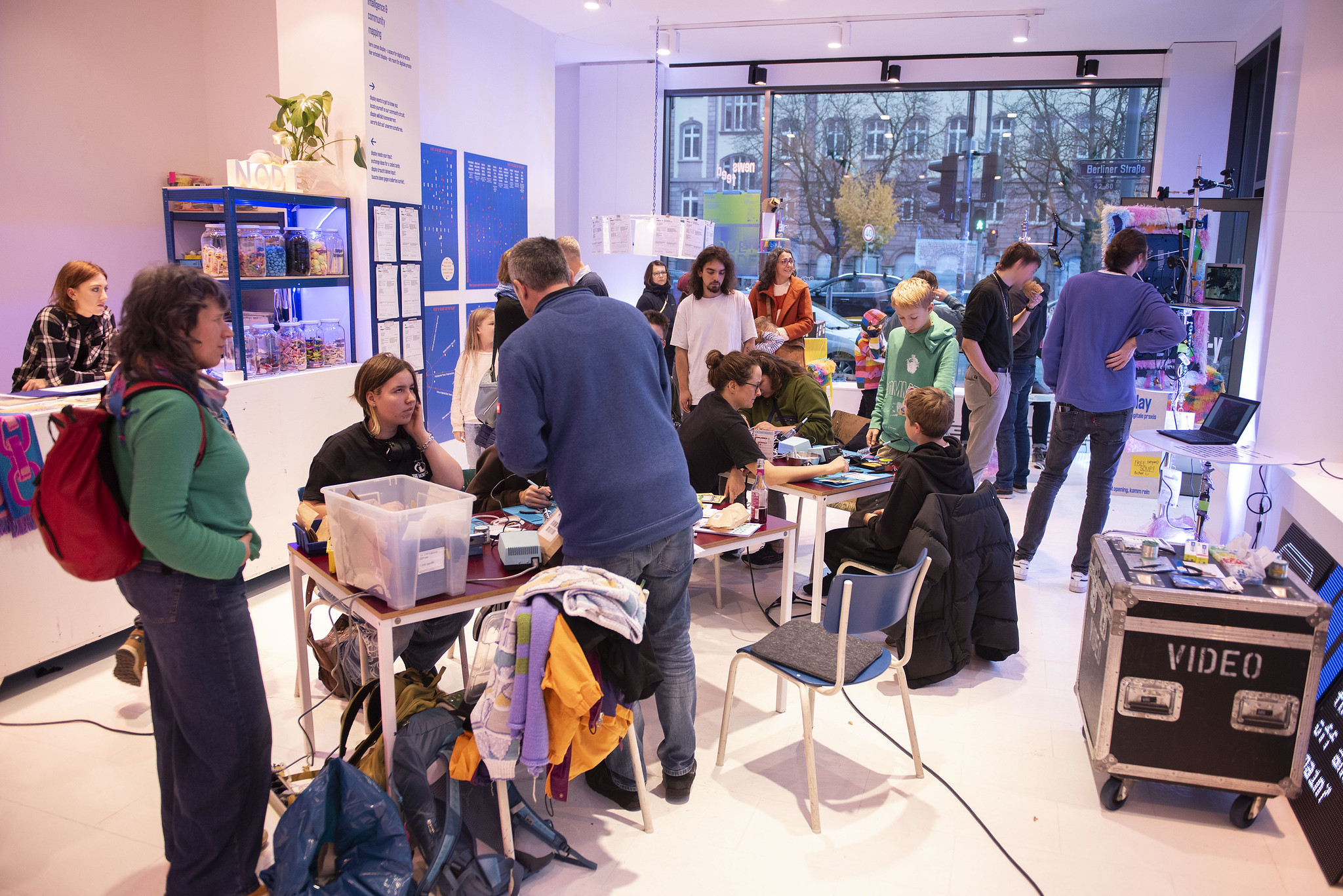
Over six days, a wonderfully mixed crowd brought the space to life: museum folks, public library teams, students, artists, designers, coders, long-time NODE community members, kids and teens with their families and people who discovered us completely by accident. This diversity showed us exactly what we hope display will become: an open space for curiosity, exchange and hands-on experimentation.

From coding and hacking to spontaneous Open House conversations and evening meetups with great creators, the space quickly showed how much is possible here. People sat down, took notes, got creative, asked about workshops, collaborations and future formats.

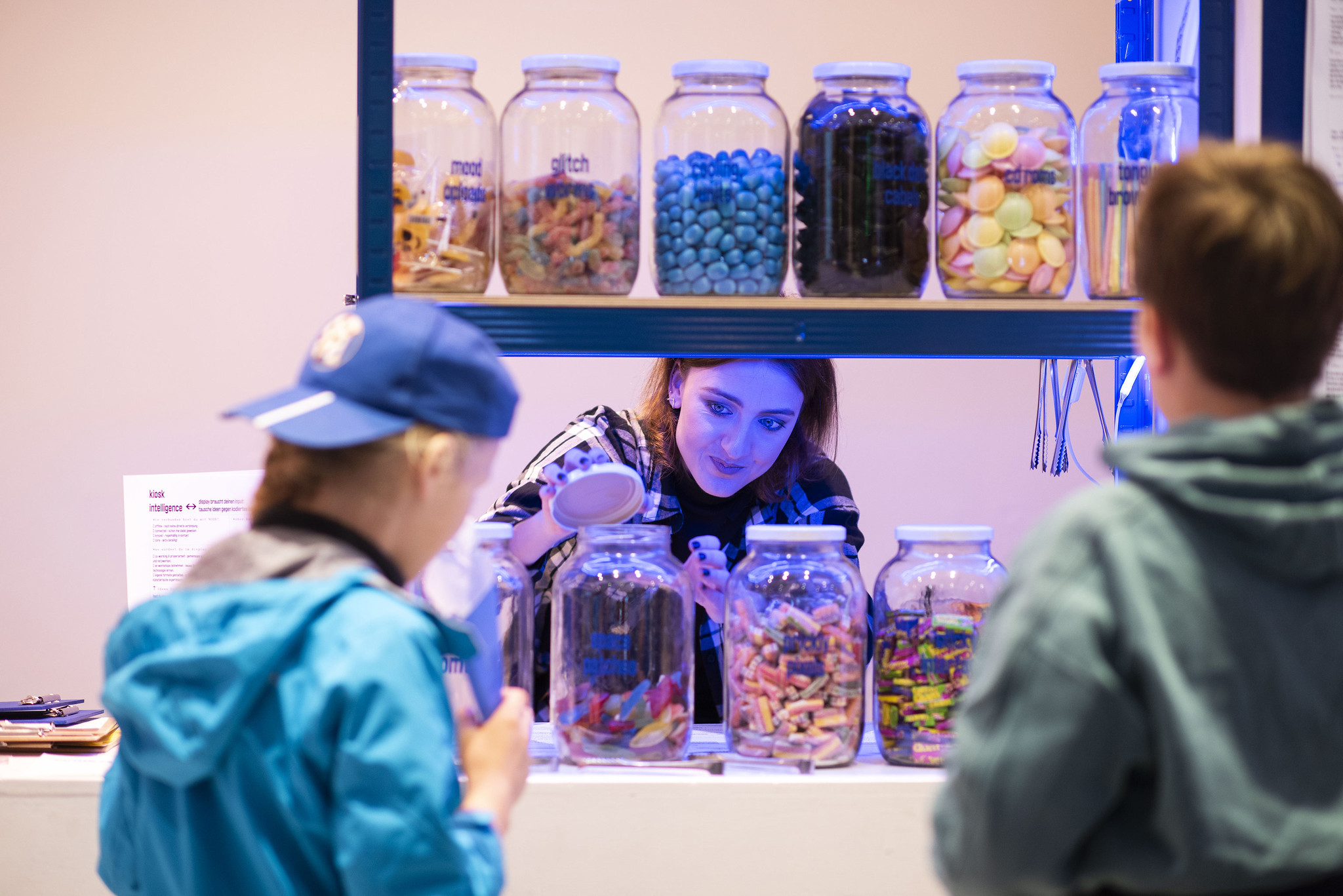
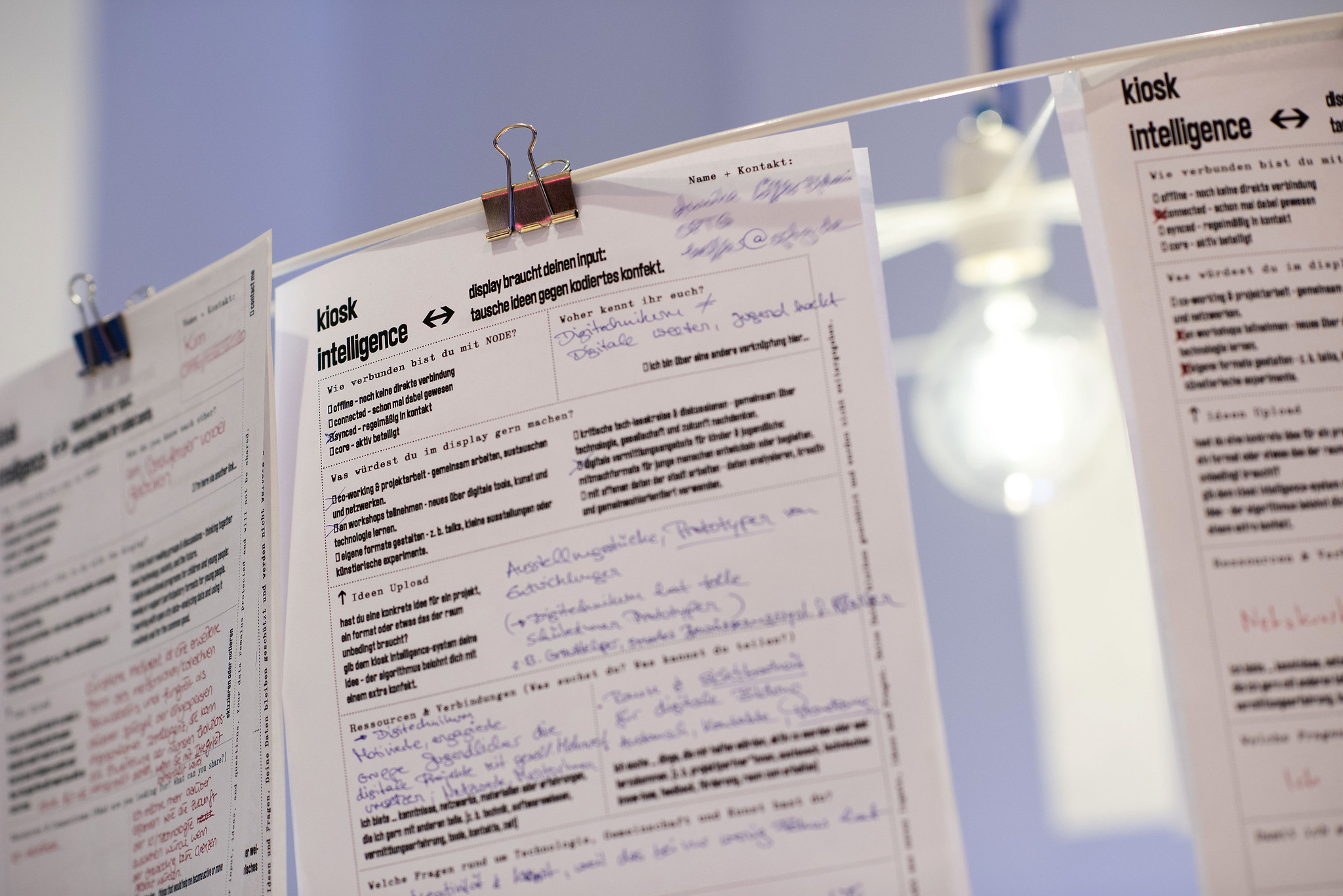
The secret star of the week? The Kiosk Intelligence and its algorithmically assembled candy bags. Almost nobody left without getting one.

The atmosphere? Open, curious, a little wild. Many visitors told us that Frankfurt has been missing a place like this: a space that is playful and critical at the same time, that doesn’t belong to one discipline or community, but instead invites all curious minds in. display will be a meeting point between digital civil society, city administration and the people of Frankfurt who want to explore technology, art, community, or simply enjoy a warm bowl of soup.
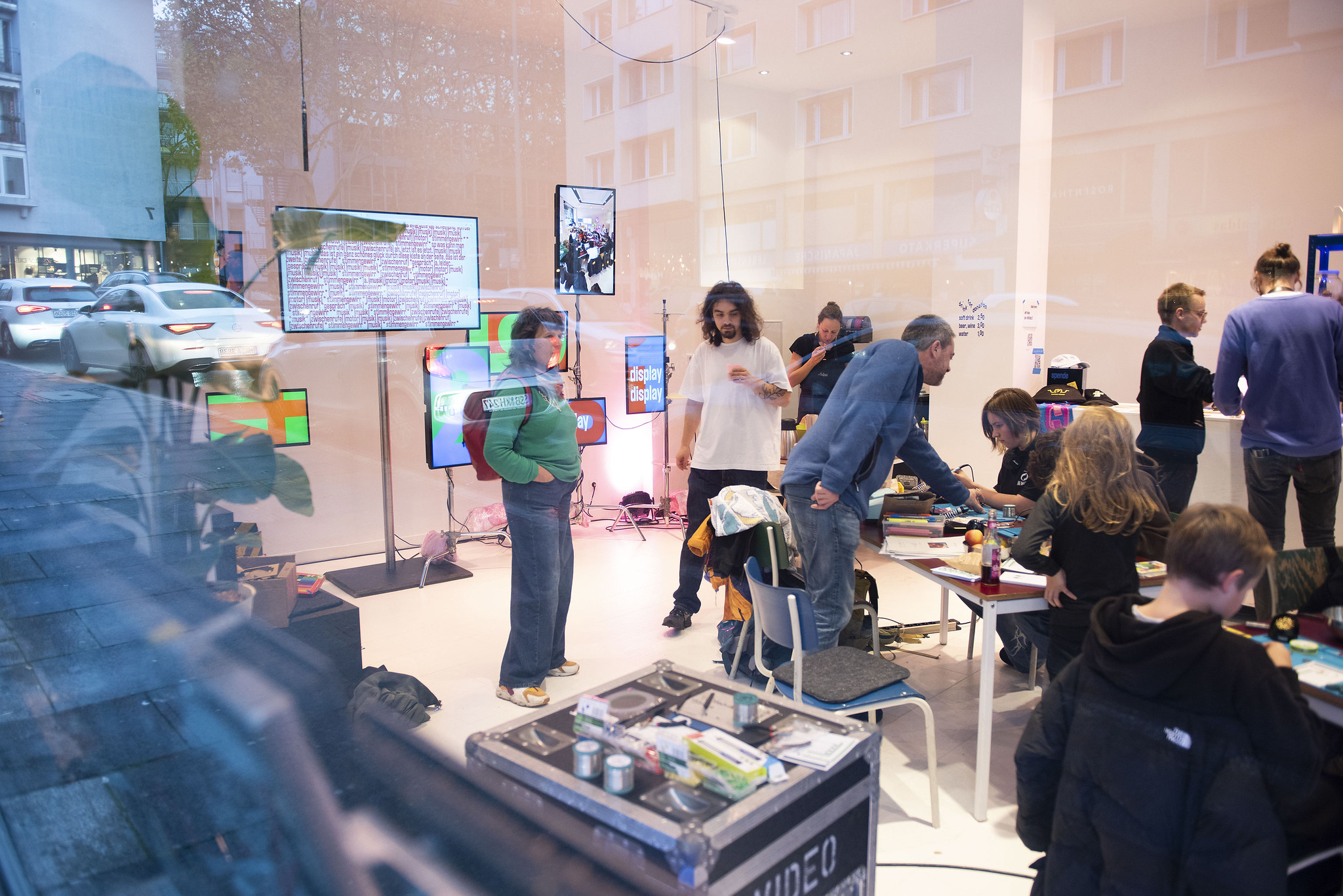
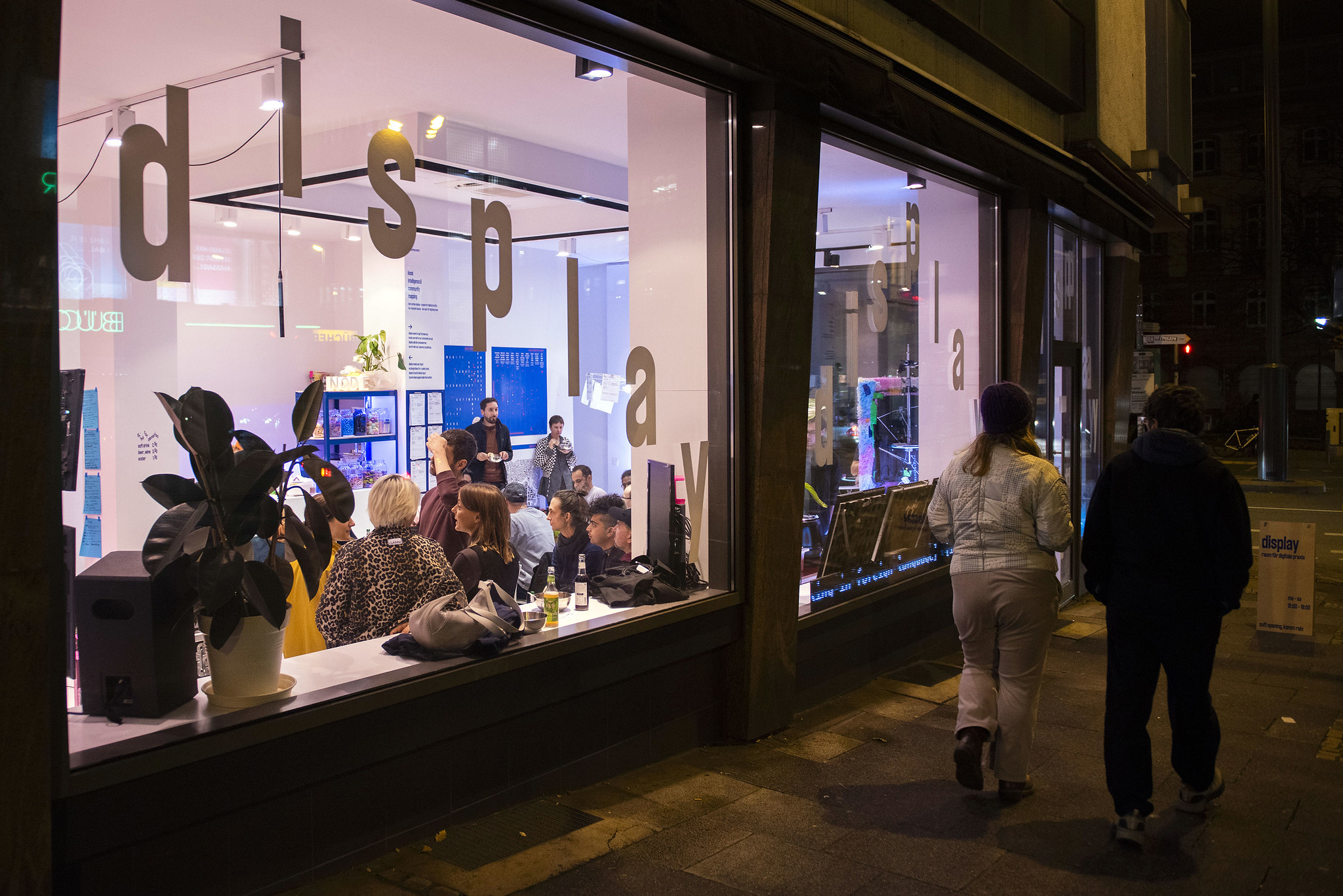
Shot through a window, we see people in a crowded space, in front of an arrangement of colorful digital screens


[DE]

✨ Die Soft Opening Woche im display ist vorbei und es war großartig! DANKE an alle, die vorbeigekommen sind, reingeschaut haben, an Events teilgenommen haben, eine leuchtende Karte gebastelt haben, sich bei einer Suppe mit uns unterhalten haben oder einfach nur gefragt haben: „Äh… was ist denn hier so los?“
Unsere Soft Opening Woche war der allererste Testlauf für display und der Raum fühlte sich bereits lebendig, warm und voller Potenzial an. 


was ist display?

display ist der neue Raum für digitale Praxis im Zentrum Frankfurts. Als begehbarer Screen und Interface, Experimentierlabor und Community-Space fördert er die kreative, kritische und praktische Auseinandersetzung mit Technologie.

Geplant und umgesetzt wird der Raum in Kooperation mit der Stabsstelle Digitalisierung der Stadt Frankfurt am Main. Gemeinsam schaffen wir Raum für Workshops, Community, Diskurs und Vernetzung und somit ein Interface zwischen unseren Themen und der Stadtgesellschaft.
 

ein softer Start….

Sechs Tage lang hat eine wunderbar gemischte Gruppe den Raum mit Leben erfüllt: Menschen aus Museen, Teams aus öffentlichen Bibliotheken, Studierende, Künstler*innen, Designer*innen, Programmierer*innen, langjährige Mitglieder der NODE-Community, Kinder und Jugendliche mit ihren Familien und Menschen, die uns ganz zufällig entdeckt haben. Diese Vielfalt hat uns genau gezeigt, was wir uns für display wünschen: einen offenen Raum für Neugierige, Austausch und praktische Experimente.

Von Programmieren und Hacken bis hin zu spontanen Open-House-Gesprächen und abendlichen Meetups mit großartigen Kreativen zeigte der Raum schnell, wie viel hier möglich ist. Die Leute setzten sich hin, machten sich Notizen, wurden kreativ, fragten nach Workshops, Kooperationen und zukünftigen Formaten.
 

Der heimliche Star der Woche? Die Kiosk Intelligence und ihre algorithmisch zusammengestellten Bonbontüten. Fast niemand ging ohne eine davon.

Die Atmosphäre? Offen, neugierig, ein bisschen wild. Viele Besucher*innen sagten uns, dass in Frankfurt ein Ort wie dieser bisher gefehlt hat: ein Raum, der spielerisch und kritisch zugleich ist, der nicht zu einer bestimmten Disziplin oder Community gehört, sondern alle Neugierigen willkommen heißt. display wird zu einem Treffpunkt für digitale Zivilgesellschaft, Menschen aus der Stadtverwaltung und Menschen in Frankfurt, die sich für Technologie, Kunst und Community interessieren oder einfach nur eine warme Suppe löffeln möchten.


what was the week like?

DAY 1 – Open House + Smart City Roundtable

We opened display together with Eileen O’Sullivan and introduced the press to what this new space will become. This was a first glimpse of our early program ideas, the display-bot: the tiny local AI we’ll build with the communiy and the Kiosk Intelligence installation by artist Sarah Wenzinger (aka: where the mysterious algorithmic candy bags came from).

At noon, the Digitalization Department of the City of Frankfurt am Main had invited professionals from the fields of culture, education and social work to a round table and, together with us, proudly presented our shared project.

In the afternoon, a group of super creative communication design students from Hochschule Mainz hacked our LED panels and tried to create big emotions in very few pixels.


DAY 2 – Community Day

The beginning of the day was calm – perfect for curious walk-ins and candy hunters. In the afternoon, our Digitale Welten workshop team met to brainstorm future youth formats. In the evening, the NODE community arrived: alumni, old team members, long-time collaborators. Kat and Jeanne had prepared a warming vegan lentil soup, there were many reunions and warm exchanges.


DAY 3 – NODE+CODE meetup #22.1 with Navid Navab

One of our fullest days! People came to ask about AI, upcoming workshops and the space itself. In the evening, artist Navid Navab gave a mesmerising talk on resonance, chaos and sound. With custom-built instruments, alchemy references and programmed systems. Soup included


DAY 4 – Open House

A quiet day but full of curious passersby who came in for questions, coffee and candy. We learned: the space really starts to glow when a specific program is happening. But even on slow days, people stayed, chatted and explored.


DAY 5 – NODE+CODE meetup #22.2 with Aurélie Herbelot

A truly special evening! Computer linguist Aurélie explained how AI actually works and what are its tricky sides. We learned how to build a bot from scratch. This was the beginning of our very own display-mascot. We’ll continue in 2026, stay tuned!


DAY 6 – Digitale Welten Open Hackday

Kids, teens, parents – the room was buzzing. The Kiosk Intelligence and the soldering stations were huge hits and two workshop leads helped young inventors bring their mini-projects to life.

wie war die Woche?

TAG 1 – Tag der offenen Tür + Smart City Roundtable

Gemeinsam mit unserer Frankfurter Dezernentin für Digitales, Bürger*innen und Internationales Eileen O’Sullivan haben wir display eröffnet und der Presse vorgestellt, was dieser neue Raum werden soll. Es gab einen ersten Einblick in unsere Programmideen, unser display-Maskottchen (die lokale Tiny-KI, die wir gemeinsam mit Aurélie Herbelot entwickeln werden) und die Installation „Kiosk Intelligence” der Künstlerin Sarah Wenzinger (alias: woher die mysteriösen algorithmischen Bonbontüten kamen).

Unsere Partner der Stabsstelle Digitalisierung der Stadt Frankfurt am Main luden anschließend Menschen aus den Bereichen Kultur, Bildung und Soziales zum Round Table und wir präsentierten stolz unser gemeinsames Projekt.

Am Nachmittag hackte eine Gruppe superkreativer Kommunikationsdesign-Studendierender der Hochschule Mainz unsere LED-Panels und versuchte, mit wenigen Pixeln große Emotionen zu erzeugen.


TAG 2 – Community-Tag

Der Tag begann ruhig – perfekt für neugierige Besucher*innen und Süßigkeitenjäger. Am Nachmittag traf sich unser Digitale Welten-Workshop-Team, um über zukünftige Jugendformate zu brainstormen. Am Abend kam die NODE-Community vorbei: Alumni, ehemalige Teammitglieder, langjährige Mitarbeiter. Kat und Jeanne haben vegane Linsensuppe für alle gekocht und es gab viel Wiedersehensfreude und herzliche Gespräche.


TAG 3 – NODE+CODE Meetup #22.1 mit Navid Navab

Einer unserer vollsten Tage! Die Leute kamen, um sich über KI, bevorstehende Workshops und den Raum selbst zu informieren. Am Abend hielt der Künstler Navid Navab einen faszinierenden Vortrag über Resonanz, Chaos und Klang. Mit maßgeschneiderten Instrumenten, Alchemie-Referenzen und programmierten Systemen. Suppe inklusive.
TAG 4 – Tag der offenen Tür

Ein ruhiger Tag, aber voller neugieriger Passant*innen, die hereinkamen, um Fragen zu stellen, Kaffee zu trinken und Süßigkeiten zu naschen. Wir haben gelernt: Auch an ruhigen Tagen blieben die Leute, unterhielten sich und erkundeten den Raum.


TAG 5 – NODE+CODE Meetup #22.2 mit Aurélie Herbelot

Ein ganz besonderer Abend! Die Computerlinguistin Aurélie erklärte, wie KI tatsächlich funktioniert und wo ihre Tücken liegen. Wir lernten, wie man einen Bot von Grund auf neu programmiert. Das Meetup war zugleich der Start für die Entwicklung unseres ganz eigenen display-Maskottchens. Weiter geht’s in 2026, bleibt dran!


TAG 6 – Digitale Welten Open Hackday

Kinder, Jugendliche, Eltern – der Raum war voller Bastel-Energie und guter Stimmung. Die Kiosk Intelligence und die Lötstationen waren ein großer Erfolg, und zwei Workshopleiter*innen halfen jungen Erfinder*innen dabei, ihre Mini-Projekte zum Leben zu erwecken.

  • 1 week

  • 300 visitors

  • 20 artworks

  • 4 soups variations

  • 8 events


what’s next?

And while we are working on our makeover, we can already reveal this much: mark February in your calendar!

display will soon run workshops, meetups, exhibitions and will be open for your ideas. Reach out for info and ideas on how to use the space via hello@d-i-s-p-l-a-y.de and our team will respond right away.


wie geht’s weiter?

Während wir an unserem Make Over arbeiten, können wir euch bereits verraten: haltet euch den Februar frei!!

display wird bald Workshops, Meetups und Ausstellungen veranstalten und ist offen für eure Ideen. Schreibt uns an hello@d-i-s-p-l-a-y.de für Infos und Ideen zur Nutzung des Raums – unser Team meldet sich umgehend bei euch.

Fotos: Eda Temucin


Partner*innen

display is being planned and implemented in cooperation with the Digitalization Department of the City of Frankfurt am Main. // [DE] Geplant und realisiert wird display in Kooperation mit der Stabsstelle Digitalisierung der Stadt Frankfurt am Main


The soft opening took place as part of the “Network Policy & Digitization Action Days” organized by the State Centers for Political Education. A big thank you goes to everyone who supported the soft opening, especially Department V – International Affairs, Digitalization, and Citizens – with special thanks to Eileen O’Sullivan! The students of Mainz University of Applied Sciences, Yrd.Works, Sarah Wenzinger, Aurélie Herbelot, Navid Navab, and the entire NODE team also contributed to and supported the program. // [DE] Das Soft Opening fand im Rahmen der “Aktionstage Netzpolitik & Digitalisierung” der Landeszentralen für politische Bildung statt. Ein großer Dank gilt allen, die das Soft Opening unterstützt haben und insbesondere das Dezernat V – Internationale Angelegenheiten, Digitalisierung und Bürger – mit einem großen Dank an Eileen O’Sullivan! Außerdem am Programm mitgewirkt und unterstützt haben wie die Studierenden der Hochschule Mainz, Yrd.Works, Sarah Wenzinger, Aurélie Herbelot, Navid Navab und das gesamte NODE-Team.


display

Berliner Str. 60

60311 Frankfurt/Main, Germany



See you in February!


Contributors


Soft Opening Partners

 
Photos by Eda Temucin
 

Japanese creative coder, artist and PhD researcher Naoto Hieda shared how his work with code informed his formal and poetic approach to all means of contemporary expression – from browsers to paper drawings. As an artist with neurodiversity/-queerness, their practice lies in collecting and giving a new life to what is left – a screen recording of a live-coded improvisation becomes a YouTube link, a drawing of the trees they spontaneously danced for gets superimposed on their childhood painting or a memory of a meaningless movement turning the ashtray while having a conversation with a friend on a rooftop bar becomes a collectible card.

Kit Kuksenok, artist, writer, and coder, held a lecture performance named Code Work, that reflects on the adoption, adaptation, and refusal of software practices in professional and everyday contexts. Their work on Code Work started as ethnographic investigation of programing practices in oceanography research as part of their PhD, exploring adoption and adaptation. Since then, Kit has explored, through images and movement, the sociality of body data, its capacity for betrayal, and refusal practices.

This time around, we met at Berliner Straße 60, but as always, the talks of the evening opened up a lot of conversations – we chatted a lot, had some delicious soup!


Contributors

 
  • 3 moderators

  • 2 contributors

  • 38 community members

  • meetup #21

  • great spicy soup

Funding

The project is funded in the program “Promotion of Cultural and Creative Industries Institutions” by the Hessian Ministry of Economy, Energy, Transport and Housing.


In collaboration with


The opening evening focused on exchanging ideas and reflecting on personal positions within contemporary design. Together, we examined strategies for designing from the inside out, developing a shared vocabulary for thinking critically about technology and its infrastructures.

Day two shifted into making: participants experimented with layout and publication using an unconventional medium – Google Sheets. This playful constraint became a space for creative resistance, testing how a corporate productivity tool could be reimagined for visual expression.

The result was a collaboratively produced book containing seven chapters, each authored and designed by a different participant. These chapters offered diverse perspectives on subversion, from poetic interventions to system-level critiques. Designed entirely in Google Sheets, the zine pushes the limits of the platform’s visual capabilities and unfolds into a poster for OffScript Vol. 1.

The workshop combined research, dialogue, and making into a cohesive experiment in alternative publishing – and set the tone for future editions. Thank you to all contributors and participants – see you at OffScript Vol. 2!

 
Photos by Eda Temucin
 

Offenbach based artists Carolin Liebl and Nikolas Schmid-Pfähler create sculptures and installations that explore the aesthetic, social and ecological effects of technological developments, using elements of robotics and scientific processes. In their works, material qualities of a visual and haptic nature are just as important as programmed processes, physical laws and chemical reactions.

Carolin and Nikolas spoke to us about their generative artwork RE:PLACES, that centres around a robotic construction that extrudes different colored sculptures made from PLA, like three-dimensional brush strokes. While giving us insight into their progress, they even brought us a robotic prototype to drive around the room, cool!

From Linz, Austria, we had Amir Bastan, who explores human consciousness, artificial intelligence, and robotics within media arts and interactivity frameworks. Currently a doctoral researcher at Creative Robotics and lecturer at Kunstuni Linz, Amir’s research focuses on “The Human Robot Transference,” which examines connections between psychoanalysis theories and human-robot interaction.

Amir gave us a mini-lecture about the distinction between “reality”: what is symbolically ordered and, the “Real”: what resists symbolisation. At the centre is “lack”: not simply what is missing, but what must be missing for the subject to exist. The following day, he held a 4-hour workshop deepening our understanding of robots in art.


Contributors

 
  • 3 moderators

  • 3 contributors

  • 49 community members

  • meetup #20

  • delicious soup

Funding

The project is funded in the program “Promotion of Cultural and Creative Industries Institutions” by the Hessian Ministry of Economy, Energy, Transport and Housing.


In collaboration with

Hosted by

 
Photos by Eda Temucin
 

Around the same time of our meetup, the public meeting Offenes Chaos took place at CCC Hackquarter where you can come by to discuss topics such as technology, its social impact, art, culture and education within technical environments. After arriving at welcoming CCC and meeting fellow hackers and each other, we started with the presentations of the evening.

Giving us an introduction to sleep, Martin Dörr presented Latent Entity, his participatory digital organism activated and controlled by human sleep in real time on a global scale. He shared insights into the prototyping process and his ongoing artistic research. Together, we reflected on the historical evolution and commodification of fatigue and the invisible infrastructures of capitalist-technical sleep systems.

Max Levy gave insight into Sleepdancing, a novel approach to guided sleep in the form of digital danceworks. Through choreographed bodies and choreographed code, we dove into the exploration of guided hypnosis and digital art designed for introspective relaxation.

No NODE+CODE meetup ends without fresh drinks and delicious soup — this time with help of a bar run by the CCC. Thank you for joining us again. We’ll see you again in July!


Contributors

 
  • 2 moderators

  • 2 contributors

  • 45 community members

  • meetup #19

  • delicious soup

Funding

The project is funded in the program “Promotion of Cultural and Creative Industries Institutions” by the Hessian Ministry of Economy, Energy, Transport and Housing.


In collaboration with

Hosted by

 
Photos by Eda Temucin
 

The event was inspired by the City of Frankfurt’s Stabsstelle Digitalisierung, which is planning a practical laboratory to engage citizens with the Smart City concept through accessible formats. Responding to the questions raised in this process, the students developed experimental setups, participatory tools, and artistic prototypes aimed at visualising complexity, fostering dialogue, and strengthening democratic processes in urban contexts.

Presentations

  • Devin Can introduced a physical discussion space for producing video formats, using tools that make visual information instantly available and connect citizens beyond the event.

  • Bikem Şahin presented a multiplayer game in which participants collaborate to solve digitalisation-related challenges, encouraging playful and shared learning.

  • Xinran Yin showed a construction kit for citizen participation, with 3D-printed components enabling all age groups to experiment with public space design. Xinran also presented a gesture-controlled game to make participation more engaging and personal.

  • Xenia Watson unveiled a sculptural wall object mapping the complexity of city administration actors, offering a playful way to explore and reimagine organisational structures.

The evening brought together artistic research, civic design, and public discussion in a convivial atmosphere – with free soup for all, staying true to the NODE+CODE tradition.


Contributors

 
  • 3 hosts

  • 5 contributors

  • 35 community members

  • meetup #18

  • delicious soup

Funding

The project is funded in the program “Promotion of Cultural and Creative Industries Institutions” by the Hessian Ministry of Economy, Energy, Transport and Housing.


In collaboration with

Hosted by

Agentur des städtischen Wandels

 
Photos by Eda Temucin
 

The Meetup evening was dedicated to the topic of hybrid publishing – so it was very fitting that we collaborated with the DASH bookshop and publishing house in Frankfurt.

The evening opened with a keynote speech by Julien Taquet, who we had invited from France specifically because he played a key role in the development of the open source framework “paged.js”, which can be used to design print products using code.


To show the breadth of hybrid publishing, ten other designers were also invited to give brief insights into their hybrid publications. This demonstrated a huge range of approaches and tools:

First, Paul Eßer, Lars Hembacher and Joanna Greiner presented their work “Hybrid Publishing Systems”. Created as part of a course at Mainz University of Applied Sciences, this publication combines the projects, essays, research and a glossary as a dynamic website, the contents of which can be printed in full or as a publication in parts.

Rebecca Herold then spoke about “Digital Artifacts”, a hybrid web archive about glitch art that makes digital art digitally explorable and at the same time offers the opportunity to create your own analog publication.

Hannah Gmeiner then presented her bachelor’s thesis “Permacomputing as a practice for digital Graphic Design”, in which she used various experiments to investigate how permacomputing principles can be applied in digital graphic design. As a web-to-print publication, it shows the possibilities of environmentally conscious design in an equally sustainable publication framework.

Anna-Lena Oehm then showed “Gathering Softly”, a digital collection of collections that explores the archiving of web content and its impact on web-based design, exploring web-to-print practice as an archiving method.


Lars Hembacher, Paul Eßer and Jean Böhm presented their KiTeGG publication, which Paul had already introduced in his impromptu talk at the previous Meetup. They gave in-depth insights into the collaborative creation process of the hybrid publication, as well as the use of AI as a central component of the research project and the publication design.

Francesco Scheffczyk spoke about his hybrid publication “Creative Pattern Recognition”, in which the intersection of artificial intelligence and creative practices is examined through interviews, reflections and analyses. Using a chat interface, the content as well as opportunities, challenges and ethical aspects of the creative process can be explored intuitively.

The web-to-print publication “Anti-Environments” by Luis Borchardt explores alternative design processes and unconventional digital tools to challenge established norms and encourage creative approaches, and has itself been unusually implemented using Google Sheets.

Finally, Clemens Hornemann presented “3* !”, a completely different kind of hybrid publication. The performance scorebook contains 99 conceptual, written artworks and explores the relationship between analog and digital space. The content is distributed digitally in comment columns on various websites and linked to the analog archive with QR codes.


As always, we ended the evening together. Over soup and drinks, the visitors had in-depth conversations about their working methods and challenges, shared project details and got to know each other better.

 
  • 3 moderators

  • 11 contributors

  • 60 community members

  • meetup #17

  • delicious soup


Contributors


Funding

The project is funded in the program “Promotion of Cultural and Creative Industries Institutions” by the Hessian Ministry of Economy, Energy, Transport and Housing.


In collaboration with


Hosted by

 
Photos by Eda Temucin


Contributors

 
  • 2 moderators

  • 2 contributors

  • 45 community members

  • meetup #16

  • delicious soup

Funding

The project is funded in the program “Promotion of Cultural and Creative Industries Institutions” by the Hessian Ministry of Economy, Energy, Transport and Housing.


In collaboration with

Hosted by


Together, we asked: How do curatorial practices and digital media shape what we learn? How can critically developed, non-commercial tools challenge established hierarchies of knowledge?

Three locally developed projects showcased different approaches to annotation, collection, and narrative-building:

Constellation 2.0 – A hybrid museum experience allowing visitors to explore connections between objects in the DFF exhibitions, archives, and collections. By linking elements in new ways, Constellation fosters fresh perspectives on cinematic knowledge.

Motion Bank – David Rittershaus from Hochschule Mainz introduced this toolset, originally initiated by choreographer William Forsythe, to digitally document and analyze dance. The project has since evolved into a collaborative web application for multimodal annotation, making the knowledge inherent in dance more accessible.

Mapping Offenbach – The NODE team presented a prototype for a collaborative annotation tool, developed with METAhub and the Max-Dienemann / Salomon-Formstecher Gesellschaft. Designed to capture and layer oral histories, the tool enables users to engage with Jewish history in Offenbach as a living, evolving knowledge system.

Of course, no NODE+CODE would be complete without great conversations and a warm, delicious soup – this time lovingly prepared by DFF. A big thank you to our hosts and everyone who joined us!


In collaboration with

Hosted by

Photos by Eda Temucin
 

What is Creative Coding?

As Wikipedia frames it, Creative coding “is a type of computer programming in which the goal is to create something expressive instead of something functional. It is used to create live visuals and for VJing, as well as creating visual art and design, entertainment (e.g. video games), art installations, projections and projection mapping, sound art, advertising, product prototypes, and much more.”

Joreg and Eno presented their journey from starting to explore computers as creative means of expression to understanding that with creative coding tools they were able to find solutions to almost any challenge and get to DIY-build their ideas from scratch.
Join our community to learn more about it, to get to code yourself!


Contributors

For this meetup, we are having our long-term member and co-founder of the visual programming language vvvv Joreg as a guest from Berlin.

 
  • 2 moderators

  • 2 contributors

  • 45 community members

  • meetup #14

  • two delicious soups: lentil & vegetable

In collaboration with

Hosted by

Photos by Christian Schuller


Contributors

For this meetup, we invited Ola Bonati and Brendan Howell will report directly from the permacomputing community and their activities around sustainability in design and computation.

Next to that we will have Felix Große-Lohmann tell us something about the local initiative „MFA – Material für Alle from Frankfurt. The initiative is committed to enabling more sustainable circulation of materials in the Frankfurt cultural production.

 
  • 2 moderators

  • 3 contributors

  • 40 community members

  • meetup #13

  • two delicious soups: red beet & pumpkin


Funding

The project is funded in the program “Promotion of Cultural and Creative Industries Institutions” by the Hessian Ministry of Economy, Energy, Transport and Housing.

In collaboration with

 
Photos by Christian Schuller


Contributors

  • 2 hosts

  • 8 players

  • 70 community members

  • meetup #12

  • one delicious lentil potato stew


Funding

The project is funded in the program “Promotion of Cultural and Creative Industries Institutions” by the Hessian Ministry of Economy, Energy, Transport and Housing.

In collaboration with

 
Photos by Christian Schuller
 

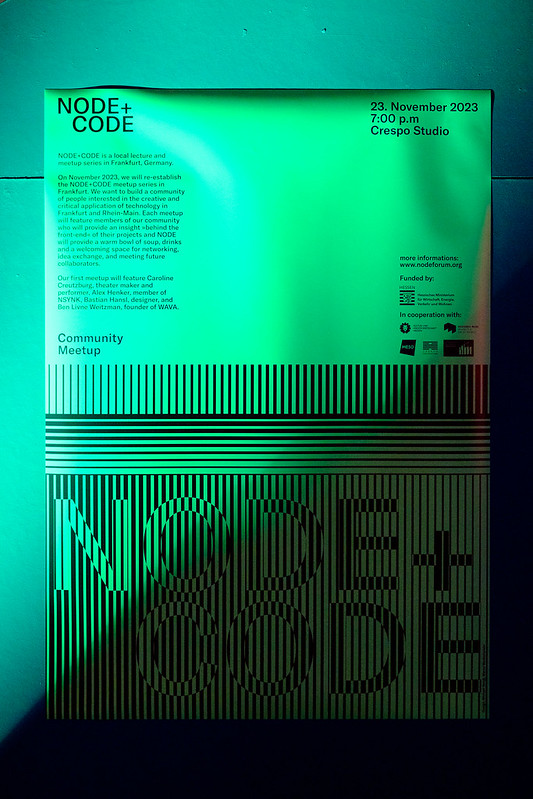
In our first meetup, we got to know the work of artists working with extended reality technologies as well as powerful VR and AI tools developed by colleagues in Rhein-Main.


Caroline Creutzburg presented „Muskeln mit drei Frauen“, an interactive theater performance where the audience navigates through the animated worlds of three very different women.The piece features unusual interactions with joysticks and sensors. 

Ben Livne Weitzman is one of the founders of WAVA, a Frankfurt-based platform for site-specific virtual art. He presented the recent exhibition DEMO and shared thoughts on virtual interventions, communal platforming, and the augmented space of appearance.

From a design perspective, Bastian Hansl demonstrated different open source tools and frameworks to gain control over generative AI. He shared his own experiences and insight into a commercial use-case. 

NSYNK is a digital design studio, based in Frankfurt, made up of an inquisitive, interdisciplinary and international group of individuals. Their member Alex Henker presented their Mixed Reality project »Hyperslides«, a platform that allows for shared spatial and immersive experiences for remote audiences and is funded by the ‘Distr@l’ innovation fund of the state of Hessen.


Contributors

  • 4 speakers

  • 50 community members

  • meetup #11

  • one delicious pumpkin stew


Funding

The project is funded in the program “Promotion of Cultural and Creative Industries Institutions” by the Hessian Ministry of Economy, Energy, Transport and Housing.

In collaboration with


Credits

Concept and artistic direction BBB (Alla Popp & Alex Sahm)
Sound composition, visual design world and characters Alex Sahm, Alla Popp
Graphic Design/ Illustration Ksti Hu
3D Design/ Technical Implementation Valentin Oellers / Lars Thomas
Mozilla.Hubs implementation Gloria Schulz
Lyrics Alla Popp, Elvina Valieva, Sarah Wenzinger
Dramaturgy Sarah Wenzinger
Saxophone Can Nicolas Winter
Cello Valentin Oellers

Production by BBB_ in cooperation with NODE Forum for Digital Arts.
The creation of Songs of Cyborgeoise is funded by Musikfonds e.V. by means of the Federal Government Commissioner for Culture and the Media.

Photo by @KstiHu


Your hosts


Your hosts