Skip to content
  • N • DE
  • PROJECTS
  • FESTIVAL
  • display
  • Digitale Welten
  • ABOUT
  • SUPPORT US

Tag: art

When you pay your groceries at the supermarket checkout, the thermal printer that prints the receipt is just something usual that would not particularly get your attention. But when you take this device out of the supermarket and use it to design a poster, it suddenly becomes un-usual. The gesture of re-contextualizing and the intervention into the software create a moment of defamiliarization that makes the technology visible, opens a critical gaze and makes the technology usable as a tool for designing something new. The usual becomes unusual. This also leads to the possibility to question everyday circumstances critically. What invisible power structures are embedded in technology, how can they be made visible? Can we understand re-contextualisation as a way to make technology more accessible?

With the online-publication »re-coding everyday technologies« we want to look at how the unusual and methods that subvert can be used for a more critical understanding of everyday digital technology and what the role of design could be to enable engagement with technology. As »re-coding« we understand acts of altering or reinterpreting digital technology e.g. through intervention in their codes, but also as a change in meaning or context – changing encodings, cultural codes or hidden structures.

We are looking for contributions that re-code everyday technology or reflect the re-coding of digital technology. Areas of interest are for instance:

  • Explorations into aesthetics and interrelations of everyday / unusual media
  • Design experiments with everyday technology
    Examples / Instructions / Tutorials of unusual use of everyday digital technology
  • How subverting digital media can be revealing about the technology, the design of technology or the role of everyday digital technology in society
  • How methods of re-coding / subverting / de-familiarizing can be used in (visual) design
  • How can design as a form of counter-action make technologies visible and critically examine them?
  • Which bodies are considered when everyday tools are designed and which aren’t? How can tools be re-coded to make them more accessible for diverse audiences?
  • How can an unusual design activate audiences and elicit critical reflection?
  • How design, standards and habits are connected


The Online Publication

The online publication will take the shape of a browser-based application and can present browser-based work, concept descriptions, theoretical reflections, tutorials for recoding, documentation of installations or other experimental hybrid formats. We are specifically interested in projects that use digital media / (creative) coding and that could also be displayed on a screen (e.g. low res LED panel). Projects can be, but are not limited to, interventions, designs, theoretical or artistic perspectives or combinations.

Your contribution must be able to be shown in the browser-based publication and participants must be willing to document and open source their code for publication.

The project will be launched and shown as part of an exhibition from 11th to 20th October at the LUX Pavillon in Mainz, in collaboration with the symposium Interpose.


How to Apply

The call is open for artists, coders, designers, practitioners, students and amateurs. We are explicitly interested in contributions by artists underrepresented in tech communities.

Artist honorarium: 500€ (incl. VAT)
Deadline Open Call: 23. July, 2023

Your contribution will be compensated with a honorarium of 500 €.

To apply please send an e-mail including a short proposal (description incl. applied media of max. 1 page, PDF + sketch, video or photo, if available) for your contribution and a short bio (for potential publication, incl. work focus, interests, pronoun) to unusualmedia@nodeforum.org

The jury consists of the curatorial team of the project. You will hear back from us max. 2 weeks after the call closes.


Apply now!

Please submit a 1 page PDF with a short description, applied media + your short bio.

If you have any questions, feel free to reach out!

Apply here!


Partners


Part of the collaboration:

Working Group for Unusual Input and Output Media

VIEW

Tehran, 20. September 2016 – Arriving at the beautiful kooshk residency was already an experience worth to dedicate an own article: driving to the heart of downtown Tehran, we find an oasis run by amazing hosts and a grey grumpy Persian cat called Gombat. The reason for her grumpiness is what makes us feel just the perfect atmosphere: It is a place for coming and going but leaving traces and it is proven by a gallery of not less than 20-30 international artists decorating the walls of the comfy kooshk living room. But what we are actually here for is a venture we are trying already for the second time: bringing together two artist who, at TADAEX, start a collaboration that will take them work on a project for the next year.

TADAEX2016 schedule
A fully packed TADAEX2016 schedule.


In conversation with Lilian and Simon.

TADAEX/NODE 2016/17 exchange

The ‘dumbphne’ performer visiting TADAEX.

Our resident artists Lilian Nejatpour and Simon Weckert had already been working for almost two weeks when the NODE team arrived in Tehran. Both not resident in Tehran, they tell us to have spent the days strolling through the streets, getting to know each other and the place that is hosting them for almost a month.

We find them right in the middle of the hassle to do a video shooting, an exercise that is quite packed with challenges in a place like Tehran. Permissions, it seems, are the most delicate thing to get. For which reason? We are not sure. It is not about privacy issues, that is clear.

The ‘dumbphne’

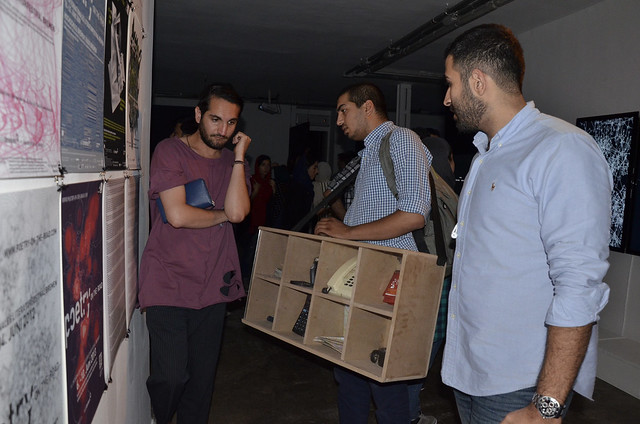
Simon and Lili are working on a video installation and a performance piece that will premiere at TADAEX 2016. Hanging out in the garden of kooshk, they are explaining their ideas and impressions, how they were connecting in the rush of this city, and how they finally found networked and mobile communication and how it is affecting our gestures and relationships globally a phenomenon they were mutually interested in. Their work ‘dumbphne’ is a performance and video piece that is playfully mimicking and exaggerating ways to use tools of a smartphone. The contact list turns into a proper book, the maps app is a classy old map of the Tehran streets, and instagram returns to his aesthetic source: a beautiful analog polaroid camera. The work is exhibited at TADAEX16 in a white cube that is, at the same time, visited by the performer with his ‘phone’ – or rather dumphne. Just as a normal gallery visitor, he looks at other works and takes a photo from time to time.

The ‘dumphne’ will be shown during NODE17, as well.


During the next days, we get to know great young artists and designers who are sharing their knowledge and are craving for the next source of inspiration. We meet curators that use digital means in the most pragmatic and clever ways to create opportunities of international exchange for their audiences. We take part in electronic AV performances that must be enjoyed while sitting. What we can feel is an undeniable quality of connection and complicity in the air – an atmosphere we are looking forward to dive deeper into…

Bonding with the Korintzky Brothers.
Bonding with the Korinsky brothers, two thirds of the ‘Korinsky Atelier für vertikale Flächen’ Sound Collective.

Lilian Nejatpour

Artist

UK / Iran

Lilian Nejatpour (*1994) has recently graduated with a BA in Fine Art and History of Art at Goldsmiths College in London. She is a British, Iranian artist concerned with technology as a mode of evolution that operates through our physical gestures and dialogue.

“It is becoming increasingly visible through overheard conservations that circle around technological invasiveness and sentimentality. I therefore questions how these two very distinct modes operate alongside each other and what problems arise when they are captured and re-situated in romantic conversation. I am delighted to be working with TADAEX & NODE in collaboration with Simon Weckert, to combine and uncover these technological methodologies further in the surroundings of both Iran and Germany.”

Simon Weckert

Artist, Designer

Berlin, Germany

Simon Weckert (*1989) is an artist and designer with his home base at the University of Art, Berlin. He likes to share knowledge on a wide range of fields from generative design to physical computing and implementation of media projects. His focus is the digital world – including everything related to code and electronics. With his love to new technologies he combines an understanding of visual, physical and interaction design with algorithmic, electronic and mechatronic knowledge. The reflection on current social aspects, ranging from technology oriented examinations to the discussion of current social issues, are always part of his work.


In collaboration with

tadaex

STAY IN TOUCH

Receive news about NODE's latest events, publications and more.


Choose your subscriptions

We use Brevo as our marketing platform. By clicking below to submit this form, you acknowledge that the information you provided will be transferred to Brevo for processing in accordance with their terms of use

GET IN TOUCH

PING@NODEFORUM.ORG


  • UPCOMING ACTIVITIES
  • IMPRINT
  • PRIVACY
  • PRESS