Featuring music exclusive to the show, new music on Noise Manifesto and reinterpretations of her remixes, Temple constructs a sonic journey through post-industrial techno, apocalyptic soundscapes and absorbing melodies. Moving away from singular interpretations, the show moves towards a multiplicity of sound, environment, surface and form.
‘Designing Hope’ as a theme, as artists or as designers, is meaningless without action. Paula Temple and Paramount Artists will donate their fee for this show to Women-in-Exile, a non-profit organisation based in Berlin/Potsdam since 2011, who campaign for the safety of refugee women and children, fight for their rights to asylum, fight the hopelessness of deportations, and defend themselves against sexualized violence, discrimination and exclusion.
Only in taking action can we have any hope for the future.
Ways you can also support Women-in-Exile:
1. Sponsor with a small monthly donation.
Donation account: Women in Exile eV
IBAN: DE21430609671152135400
BIC: GENODEM1GLS (GLS Bank)
2. Become a member.
Register by email to info@women-in-exile.net
3. Attend the next solidarity events:
02.06.2017 – Potsdam Hauptbahnhof: Demo against Deportation
05.07.2017 – Hamburg, Kampnagel: Alternative summit G20
09.07.2017 – Brandenburg at the Havel: LGBTQI Refugee Conference
19.07.2017 – Berlin: Berlin Symposium on the Protection of Refugees
More information at women-in-exile.net
Photo by Sebastian Kujas
About the Artists
Line-Up
Queen of Pack – live
TIBSLC
Psch
T-Data
The night started with TIBSLC aka ‘The Italian Billionaires Secret Love Child’ from Berlin with fine ambient sounds and Queen of Pack, a 3-piece kraut-electronic formation from Leipzig, improvising music live and delivering energetic moments for the crowd. The rest of the night we moved our feet to T-Data`s and Psch`s favorite electronic selection.
Artists
Partners

The Training Module
The Training Module addresses the lack of common knowledge surrounding electronics manufacturing through a tabletop resource sharing game. Players become trainees in this fictional electronics cooperative. They barter for materials using real electronic waste as game pieces while avoiding hazards. The goal is to complete simple circuits that become building blocks for futuristic communication devices. In this way, they contribute to new models for economics and manufacturing. The game teaches players to identify common electronic components and introduces the idea of a schematic. It uses barter, strategy, and chance to achieve its goals, raising the question of how a phone company could function in a dystopian future.
Photos by Eda Temucin and Marie Brauburger
About the Artist
The artist gave an insight into his elaborate expert system, a thorough analysis of how the status of our identity is determined by administrative frameworks and identifying features stored in various commercial and governmental databases. Starting from his works in the NODE17 exhibition “Designing Hope” participants learned how identities are built and how new identities can be created in order to seek protection from direct traceability. Bunting introduced them to the manuals he has synthesized from his own inquiries and guide the participants through the first steps of using the freely available material.
More info on The Status Project:
About the Artist
Their performance I’D RATHER BE AN IPHONE, along with their first music album release of the same name, is a play on the intersection of utopian and dystopian visions of the future that is already happening, it is a tale of partly-digitalised bodies, cyborgian-like species born to the world that had rapidly obtained a tremendous power of genesis, but is lacking a maturity to handle the complexity of the situation. In this conceptual multi-layered performance artists mediate their futuristic visions with electronic music, live-synthesized voice, emojis, visual poetry and their intense physical presence, with a theoretical approach towards trans-post-humanism, body enhancement, AI, biotechnology and robotics.
The title of the performance is taken from the statement “I’d rather be an iphone than a woman” by British theorist and feminist Helen Hester. “I’d rather be an iphone” is not only the title of the performance, but also of BBB_’s first music album. The album is accompanied by a booklet, containing a downloadable version of the album, as well as bonus tracks, videos, animations. With the Augmented Reality App “Aurasma”, the booklet can be brought to live.
Interactive light system by Karl Kliem.
Artists
About Graph Commons:
Graph Commons is a collaborative platform for making, analyzing and publishing network maps. It empowers people and organizations to transform their data into interactive maps and untangle complex relations that impact them and their communities. Graph Commons members have been using the platform for data research, investigative journalism, strategizing, organizational analysis, archival exploration, and art curating.
Fixing the now, for now.
What happened in the workshop?
We gave an overview of the dx11.particles pack and dug a bit deeper into the nodes to show, how everything works together. Also we gave an idea, how to customize the particle system for your special needs in complex projects.
In the end there was creative patching time where we answered questions. The goal was to build a creative tool in combination with 3d tracking and Virtual Reality.
Who was the target audience of the workshop?
Artists, designers and anyone who creates visual content.
In which chapters is the workshop structured?
- Quick introduction to dx11.particles
- The heart of dx11.particles: emitters, selections & modifiers
- Explanation of buffers and their job during one frame in the dx11.particles lifecycle
- How to create custom attributes, emitters, selectors and modifiers
- Creative patching / Q&A
presumed knowledge needed
Medium/good knowledge on DX11 (HLSL, Compute Shader)
Requirements
- Windows8/10 laptop with latest vvvv version and addonpack installed
- A 3 button mouse
- DX11/Shader model 5.0 graphics card
- Latest DX11 pack installed
- Latest DX11.Particles pack installed
Watch the documentary of a comparable workshop that took place at NODE Forum for Digital Arts in 2015:
Creative Coding Communities
Representatives from different Creative Coding Communities discussed several aspects of organizing a local creative coding community.
Representatives came from:
Amsterdam – Berlin – Tehran – Cairo – Utrecht – and Tilburg.
Artistic Communities
Artistic practices are in a period of evolution all over the world. Universities offer new degrees, artist groups create new communities of artistic exchange and new curatorial practices shape the art field from the bottom up to the establish art world – be it in Iran, in Kenya or in Argentina. However, there are challenges that these new fields of practice encounter globally as well.
Input 1:
The Digital Media Art Scene in Shiraz – Mohsen Hazrati and Milad Forouzandeh
Mohsen Hazrati and Milad Forouzandeh founded Dar-al-Hokoomeh, a New Media art project in Shiraz, Iran, a year after graduating from Shiraz Art Institute with the vision of creating a space for emerging artistic practices.
Dar-al-Hokoomeh has hosted exhibitions, screenings, talks, lectures and workshops and has from its inception been at the forefront of the intersection of culture, art and technology within Iran and on an international level.
Dar-al-Hokoomeh produces New Media events that are a chronological step in continuing an Iranian tradition of exploring media ranging from film to video and sound art. Not only through the exploration of the possibilities of New Media itself but also through combining this with an underlying depth, richness and humorous wit that is uniquely Shirazi.
Input 2:
The Folder Foundation – Ali Khadivar
The Folder Foundation is based in Shiraz and was established in 2017 by Ali Khadivar, an art investor and entrepreneur. It is an art sponsorship initiative focused on supporting and promoting emerging artists who are mostly – but not exclusively – active in the field of digital and new media arts. It aims to provide them with the education and the equipment they need for further developing themselves as artists. The foundation is the first in a series of planned projects, initiatives, and organisations in order to explore artistic, social, cultural, educational, technological, and the financial possibilities and intricacies of the digital, post internet era.
Input 3:
New media art and its development in Argentina – Cristian Reynaga
The context of artistic production and theoretical research of media art in Latin America reveals that its political, economical and cultural history comes from a complex social development.
The ups and downs that new media art has faced in the last 20 years in terms of production did not allow it to be a formal discipline in the institutional scene. Most of the times, the pieces reflex about itself and how the piece works or was created, and this situation avoid the perception of non-technical spectators and broad audience.
Technologically mediated immateriality redefines among others a common sense of spirituality for a virtually-optimized self. Thereby, there is a need for reconsideration of a progressive religious thought for partly digitalized bodies heading into an undefined future.
In their scenographic installation Balance Wanted and performance Buddha App Says, BBB_ explores the aspect of spirituality in a life of a technological human, appropriating mythological symbols and metaphysical attributes of belief, sense of being and hopes for divine survival, into digital and web spaces.
Ritualistic, country nonspecific, physically-trying and in step with the times, a room for meditation offers a possibility for a participatory, philosophically-oriented reflection on the representation and perception of technological spirituality. It is a room installation inspired by references to digitally enabled and web distributed tools for spiritual development, complemented by a live electronic-music performance based on mind enhancement sound technics.
This performative installation invites visitors to deep dive into a world of techno spirituality. The show takes place in both physical and virtual spaces and levels, it involves 6 performers, and is open for 4-5 hours for an unlimited number of guests.
The artistic room installation is inspired by references to digital enabled and web distributed tools for spiritual development.
Performance in collaboration with Dominik Keggenhoff.
Artists
Andi Otto has been playing his extended cello bow system (called “Fello“) already for over seven years and has invented an individual playing technique for his instrument which makes use of the space around the cello. Interestingly, the more virtuose parts of his playing really start as soon as the bow leaves the strings and continues to play with the live-recorded cello sound with gestures in the air.
During an artistic residency in Bangalore (on invitation of the Goethe-Institut) Andi and Pallavi adapted the sensor system to Pallavi’s right hand. The typical, rather involuntary gestures which accompany Pallavi’s singing in traditional Indian music can be read and translated into musical data by the sensors. This makes it possible for her to play with her “Second Voice” (this is the working title for Pallavi’s electronic instrument) which becomes audible as soon as her hand moves away from the body, changing the pitch, rhythm and timbre of the last notes sung. The superimposition of these two gestural electronic systems holds a surprisingly huge artistic potential which Andi and Pallavi have begun to explore during their development period.
The two musicians come from different backgrounds. Andi is a DJ and producer of electronic music in Hamburg who has written his PhD thesis about the history of electronic musical instruments which involve bodily gestures. Pallavi is a classical Hindustani vocalist, actress and filmmaker. They met on a theatre stage in Berlin where they performed the German adaptation of the award-winning Indian play “C Sharp C Blunt”. Parts of Andi Otto’s album “VIA” (Pingipung 2017) they have recorded together in India in 2016. A mutual curiosity towards overlapping musical cultures brought them to the studio – Andi Otto’s solo album “VIA” was only a beginning of more mutual recordings and releases to be expected in the near future.
Das passiert im Workshop:
Im Workshop bauen wir die Spionagekamera von damals mit unseren Smartphones, aus Pappe und Aluminiumblech nach – denn High-Tech aus dem vorletzten Jahrhundert ist immer noch hochaktuell und sieht auch noch ziemlich cool aus. Und nebenbei ist sie genau das richtige Protest-Tool in Zeiten der analog-digitalen Dauerüberwachung..
Die Anmeldung erfolgt über die Jugend-Einrichtung Jugendhaus Riedberg!

Wann & Wo:
30.09.2019 – Jugendhaus Riedberg, Friedrich-Dessauer-Straße 4-6, 60438 Frankfurt am Main
Wer kann mitmachen:
Menschen ab 12 Jahren. Wir freuen uns auch auf Teilnehmer*innen aller Gender und Hintergründe. Keine Vorkenntnisse notwendig!
Kosten:
Der Workshop ist dank unserer Förderer für dich kostenfrei!
Deine Workshopleiterin:
Der Workshop ist Teil von:
Gefördert von:

Das passiert im Workshop:
Im Workshop mit Carolin & Nikolas lötest du das “Gehirn” deiner Kreatur und konstruierst aus einer ganzen Menge Lichtfasern dein ganz spezielles Leuchtrobotertier… und vielleicht entstehen am Ende viele neue Bewohner*innen der Meere der Zukunft..
Die Anmeldung erfolgt über die Jugend-Einrichtungen:

Wann & Wo:
09.09.2019 – Jugend-Kultur-Werkstatt Falkenheim Gallus e.V., Herxheimer Straße 4, 60326 Frankfurt am Main
11.09.2019 – Kinder- und Jugendhaus Fechenheim, Pfortenstraße 1, 60386 Frankfurt am Main
19.09.2019 – Medien-Studio-Bornheim, Ortenberger Straße 40, 60385 Frankfurt am Main
Wer kann mitmachen:
Menschen ab 12 Jahren. Wir freuen uns auch auf Teilnehmer*innen aller Gender und Hintergründe. Keine Vorkenntnisse notwendig!
Kosten:
Der Workshop ist dank unserer Förderer für dich kostenfrei!
Deine Workshopleiter*innen:
Der Workshop ist Teil von:
Gefördert von:
Das passiert im Workshop:
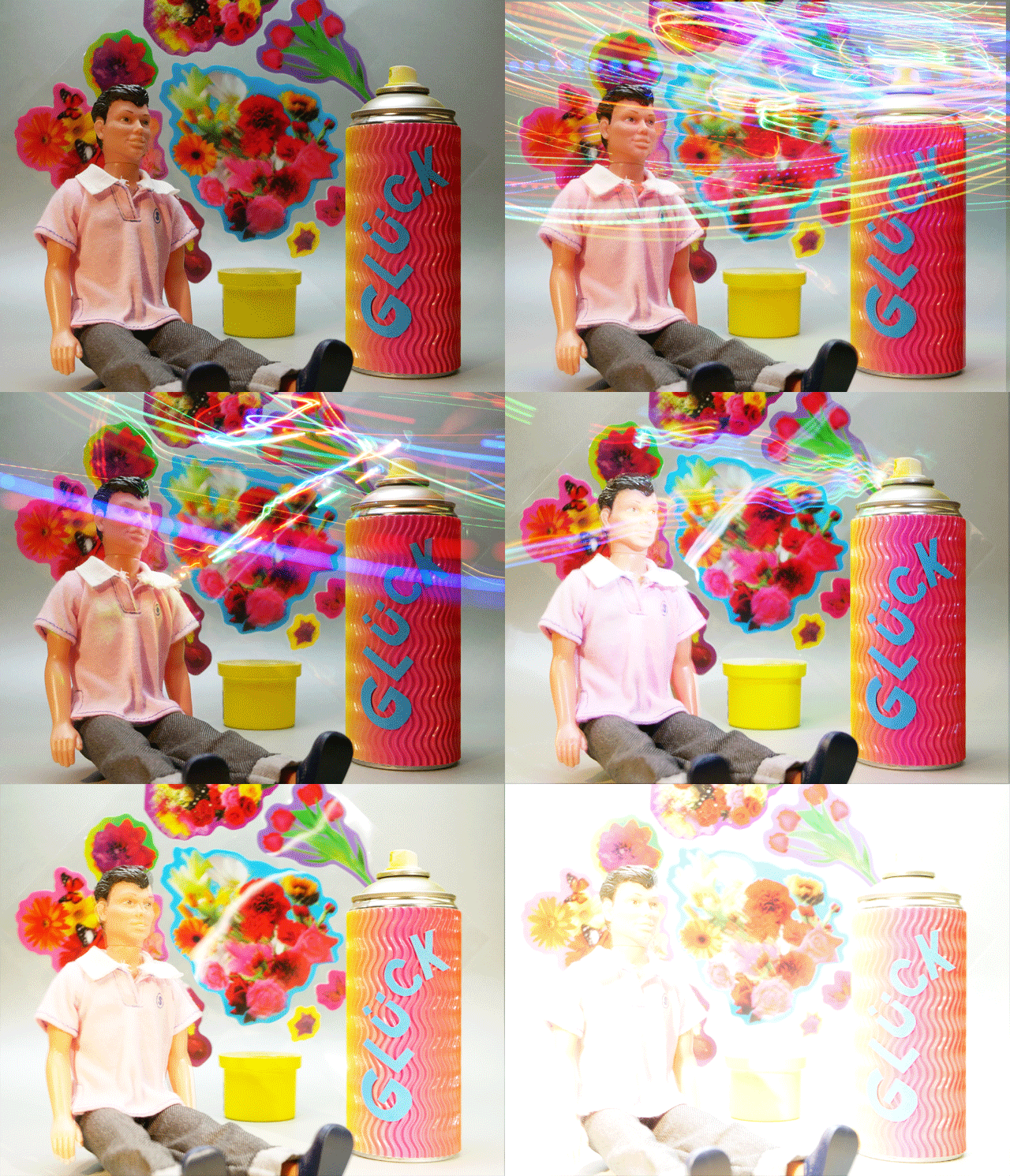
In drei Tagen lernen wir, wie echtes Produktdesign funktioniert und bauen Prototypen aus recyceltem Material, Technik und Elektronik – für unsere self-made Gadgets. Wenn du dich für augenzwinkernde Innovationen interessierst und keine Angst vor Kabelbindern und Heißklebepistolen hast, sei dabei!
Meld dich hier an!
Wann:
01. Oktober • 10-16 Uhr
02. Oktober • 10-16 Uhr
03. Oktober • 10-16 Uhr
04. Oktober • 10-15 Uhr + ab 18 Uhr Ausstellungseröffnung
Wo:
Künstlerhaus Mousonturm, Waldschmidtstraße 4, Frankfurt am Main
Wer kann mitmachen:
Menschen ab 12 Jahren. Wir freuen uns auch auf Teilnehmer*innen aller Gender und Hintergründe. Keine Vorkenntnisse notwendig!
Kosten:
Der Workshop ist dank unserer Förderer für dich kostenfrei! Für Mittagessen und Getränke wird auch gesorgt.
Deine Workshopleiterin:
Der Workshop ist Teil von:
Gefördert von: