Skip to content
  • N • DE
  • PROJECTS
  • FESTIVAL
  • display
  • Digitale Welten
  • ABOUT
  • SUPPORT US

Tag: Digital Literacy

When you pay your groceries at the supermarket checkout, the thermal printer that prints the receipt is just something usual that would not particularly get your attention. But when you take this device out of the supermarket and use it to design a poster, it suddenly becomes un-usual. The gesture of re-contextualizing and the intervention into the software create a moment of defamiliarization that makes the technology visible, opens a critical gaze and makes the technology usable as a tool for designing something new. The usual becomes unusual. This also leads to the possibility to question everyday circumstances critically. What invisible power structures are embedded in technology, how can they be made visible? Can we understand re-contextualisation as a way to make technology more accessible?

With the online-publication »re-coding everyday technologies« we want to look at how the unusual and methods that subvert can be used for a more critical understanding of everyday digital technology and what the role of design could be to enable engagement with technology. As »re-coding« we understand acts of altering or reinterpreting digital technology e.g. through intervention in their codes, but also as a change in meaning or context – changing encodings, cultural codes or hidden structures.

We are looking for contributions that re-code everyday technology or reflect the re-coding of digital technology. Areas of interest are for instance:

  • Explorations into aesthetics and interrelations of everyday / unusual media
  • Design experiments with everyday technology
    Examples / Instructions / Tutorials of unusual use of everyday digital technology
  • How subverting digital media can be revealing about the technology, the design of technology or the role of everyday digital technology in society
  • How methods of re-coding / subverting / de-familiarizing can be used in (visual) design
  • How can design as a form of counter-action make technologies visible and critically examine them?
  • Which bodies are considered when everyday tools are designed and which aren’t? How can tools be re-coded to make them more accessible for diverse audiences?
  • How can an unusual design activate audiences and elicit critical reflection?
  • How design, standards and habits are connected


The Online Publication

The online publication will take the shape of a browser-based application and can present browser-based work, concept descriptions, theoretical reflections, tutorials for recoding, documentation of installations or other experimental hybrid formats. We are specifically interested in projects that use digital media / (creative) coding and that could also be displayed on a screen (e.g. low res LED panel). Projects can be, but are not limited to, interventions, designs, theoretical or artistic perspectives or combinations.

Your contribution must be able to be shown in the browser-based publication and participants must be willing to document and open source their code for publication.

The project will be launched and shown as part of an exhibition from 11th to 20th October at the LUX Pavillon in Mainz, in collaboration with the symposium Interpose.


How to Apply

The call is open for artists, coders, designers, practitioners, students and amateurs. We are explicitly interested in contributions by artists underrepresented in tech communities.

Artist honorarium: 500€ (incl. VAT)
Deadline Open Call: 23. July, 2023

Your contribution will be compensated with a honorarium of 500 €.

To apply please send an e-mail including a short proposal (description incl. applied media of max. 1 page, PDF + sketch, video or photo, if available) for your contribution and a short bio (for potential publication, incl. work focus, interests, pronoun) to unusualmedia@nodeforum.org

The jury consists of the curatorial team of the project. You will hear back from us max. 2 weeks after the call closes.


Apply now!

Please submit a 1 page PDF with a short description, applied media + your short bio.

If you have any questions, feel free to reach out!

Apply here!


Partners


Part of the collaboration:
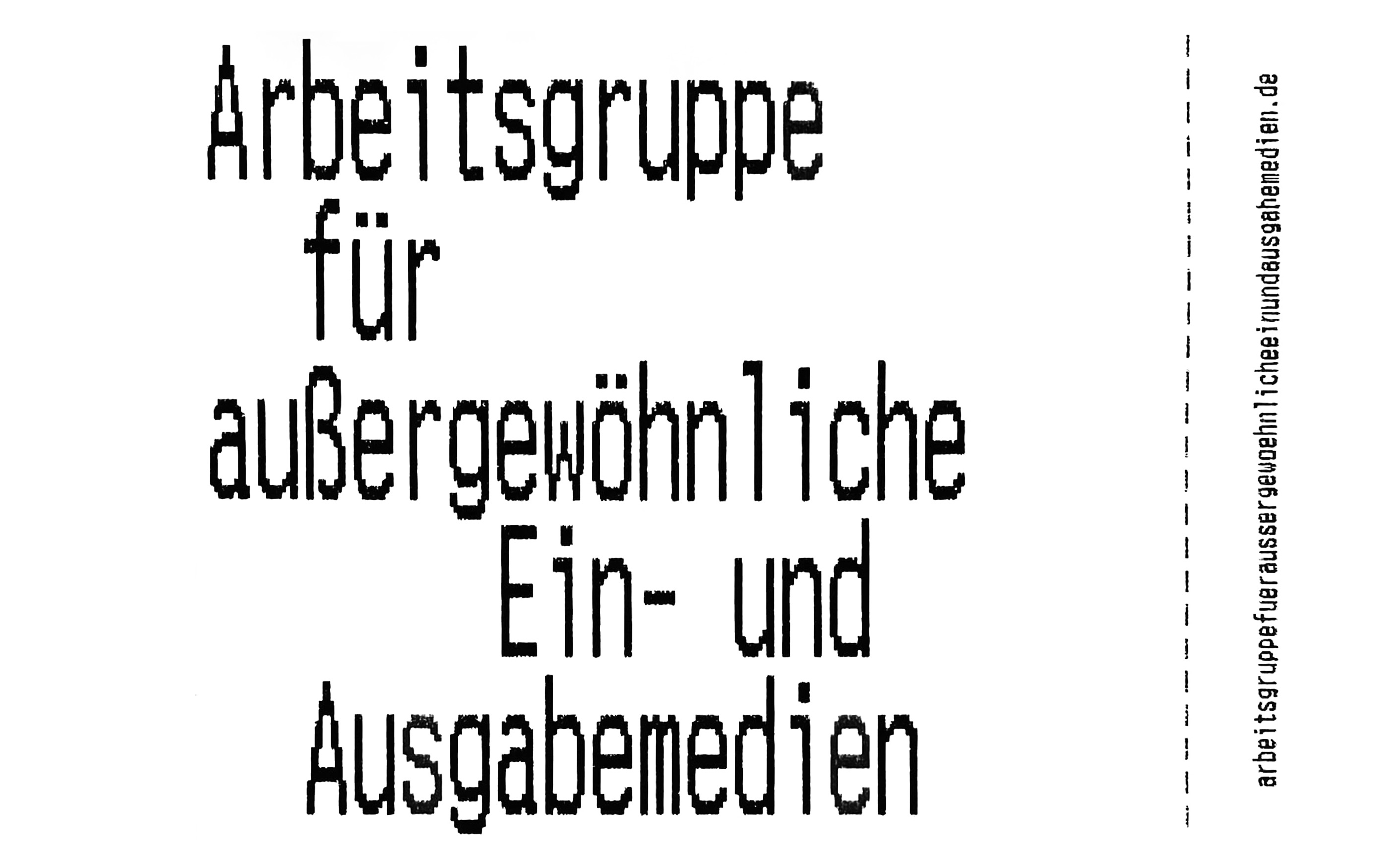
Working Group for Unusual Input and Output Media

VIEW

Vier Forderungen an die Bundesregierung

1. Digitale Souveränität:

Die Politik muss die digitale Souveränität der Gesellschaft – also die Erhaltung der Gestaltungsfähigkeit – als oberste Maxime in ihrer Digitalpolitik verankern. Statt eines Digitalministeriums brauchen wir für die kommende Legislaturperiode eine digitale Mission mit digitaler Souveränität als Leitprinzip, die mit Vertreter*innen aus Zivilgesellschaft, Wissenschaft und Wirtschaft verfasst und evaluiert wird.


2. Beteiligung und Transparenz:

Die Zivilgesellschaft muss endlich die gleichen Möglichkeiten wie Wirtschaft und Wissenschaft erhalten, um ihre Expertise einzubringen. Dies wird durch eine Zivilgesellschaftsquote in politischen Beratungsgremien, Kommunikation und Transparenz zu Abläufen politischer Entscheidungsprozesse, gesetzlich festgelegte Fristen für Konsultationen sowie maschinenlesbare Dokumentation erreicht.

3. Öffentliches Geld, öffentliches Gut:

Öffentlich geförderte Lösungen müssen für alle zugänglich sein, damit kein Wissen verloren oder Probleme doppelt gelöst werden. Deswegen muss für Staatsausgaben im digitalen Bereich gelten: „Public Money? Public Good!“ Das betrifft Software, Daten der öffentlichen Verwaltung (Open Data) sowie freies Wissen und offene Bildungsmaterialien (Open Educational Resources) gleichermaßen.


4. Nachhaltige Digitalisierung:

Die Digitalisierung kann nur dann gelingen, wenn der Aufbau von digitaler Infrastruktur wirtschaftlich, ökologisch und sozial gestaltet wird. Dazu müssen Diversität in der Digitalisierung sowie der Aufbau und die Wartung von sicheren dezentralen digitalen Infrastrukturen für die Gesellschaft langfristig gefördert werden.


Launch-Event am 5. Mai 2021

Beim Launch-Event diskutieren Julia Reda (ehem. Mitglied des EU-Parlaments), Henning Tillmann (Softwareentwickler und Co-Vorstand von D64) und Julia Kloiber (Co-Gründerin Superrr Lab) am 5. Mai 2021 von 18:00 Uhr bis 19:30 Uhr diese vier Forderungen. Moderiert wird die Runde von Katja Jäger (betterplace lab). Anschließend gibt es für alle Teilnehmenden die Möglichkeit, sich in vier Themenräumen zu Lösungen, Maßnahmen und Handlungsaufforderungen auszutauschen. Weitere Informationen und Anmeldung zum Launch-Event gibt es auf digitalezivilgesellschaft.org oder direkt >> hier.

Anmeldung zum Event


Unterzeichnende Organisationen von digitalezivilgesellschaft.org:

Superrr Lab, gut.org, betterplace lab, Social Entrepreneurship Netzwerk Deutschland e.V. (SEND), Free Software Foundation Europe, Open Knowledge Foundation Deutschland e.V., Liquid Democracy e.V., iRights.Lab, Forum InformatikerInnen für Frieden und gesellschaftliche Verantwortung e.V. (FIfF), Chaos Computer Club, Bundesverband Smart City e.V., mediale pfade, Stiftung Erneuerbare Freiheit, Center for the Cultivation of Technology, neuland21 e.V., Arbeitskreis Digitalisierung der BUNDjugend, Verstehbahnhof, Bundesnetzwerk Bürgerschaftliches Engagement, Wikimedia Deutschland e. V., Stiftung Neue Verantwortung e.V., D64, epicenter.works e.V., Digitale Gesellschaft e.V., Ashoka Deutschland e. V., Progressives Zentrum e. V., NODE Forum for Digital Arts / NODE e.V., Germanwatch e.V., Goethe-Institut, futur eins, ProjectTogether


As a winning project we will receive a funding of 25.000 € and additional guidance from the foundation and experts in the field of education. All the impulses, we will apply to initiate a local network of organizations, educators and activities for young audiences in the field of STEAM with a focus on IT, creative coding and media arts.


2. Werkstatttreffen “Digital Skills” – The winning teams regularly meet to share knowledge and experiences.


DIGITALE WELTEN started in November 2017 as a media art festival for teens in Frankfurt/Main. The first edition, in cooperation with visionale17, featured three artist workshops, an exhibition and a diverse supporting program, offering teens opportunities to engage with net-political topics, to experiment with digital technologies and thus to become active creators of our digital society.


Since then, we have been able to grow the project into an interdisciplinary network together with Jugend- und Sozialamt/Kommunales Jugendbildungswerk Frankfurt, the Institute for Art Education at Goethe University Frankfurt and experts working in public youth work in Frankfurt.

With this network, we aim at designing engaging opportunities in the field of digital media education, helping to facilitate easy transitions between offers from different initiatives and strengthen synergies between these public facilities. To this end, the network seeks to offer advanced training, organize meetings for professionals from the field and provide various formats for experimenting with technology for teens.


Stay tuned for future Digitale Welten festival editions on our website https://digitale-welten-frankfurt.org, our newsletter…

… and Jugend hack FFM 2019!


Find the German press release here!


Are you a representative of a local organization, an educator or artist and want to become part of the network? Join here!


The network is made possible by us and…


The growing network


STAY IN TOUCH

Receive news about NODE's latest events, publications and more.


Choose your subscriptions

We use Brevo as our marketing platform. By clicking below to submit this form, you acknowledge that the information you provided will be transferred to Brevo for processing in accordance with their terms of use

GET IN TOUCH

PING@NODEFORUM.ORG


  • UPCOMING ACTIVITIES
  • IMPRINT
  • PRIVACY
  • PRESS